1–5%
recovery failure rate per major survey. Over a fleet's lifetime, that adds up to hundreds of lost instruments.
ⓘ Source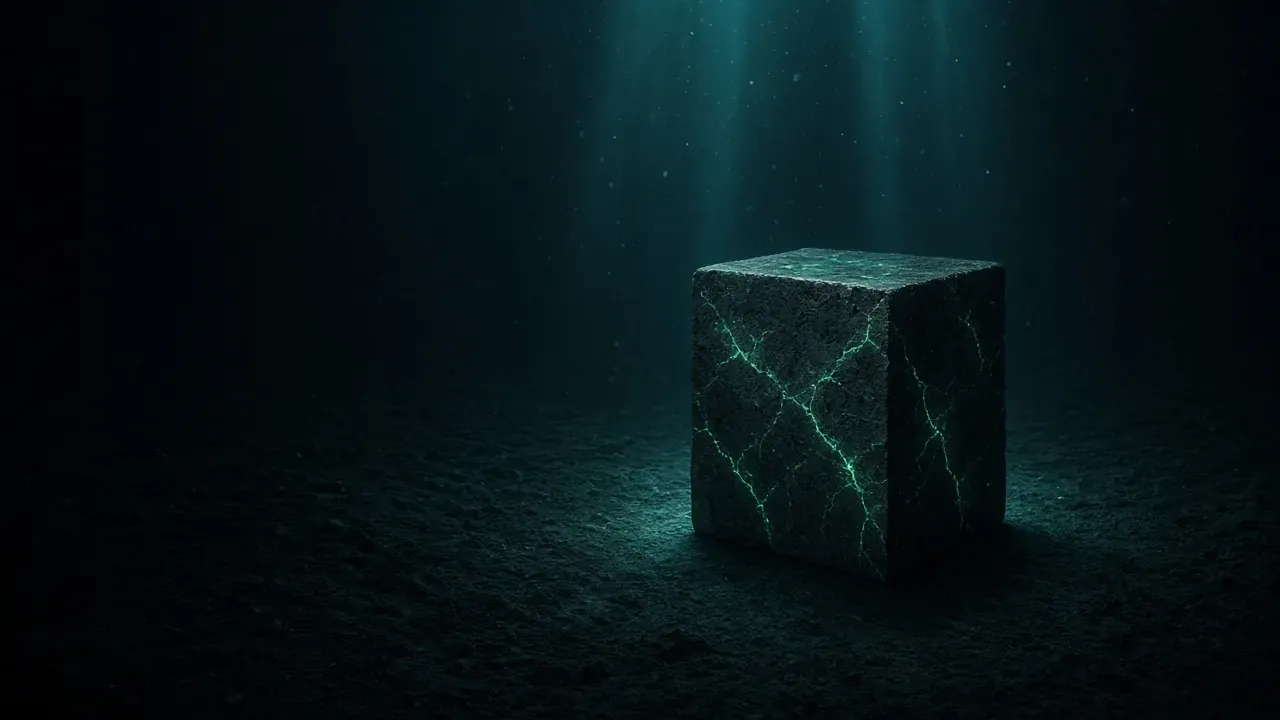
PATENT PENDING · US PROVISIONAL FILED · THESIS POSITIONS OPEN
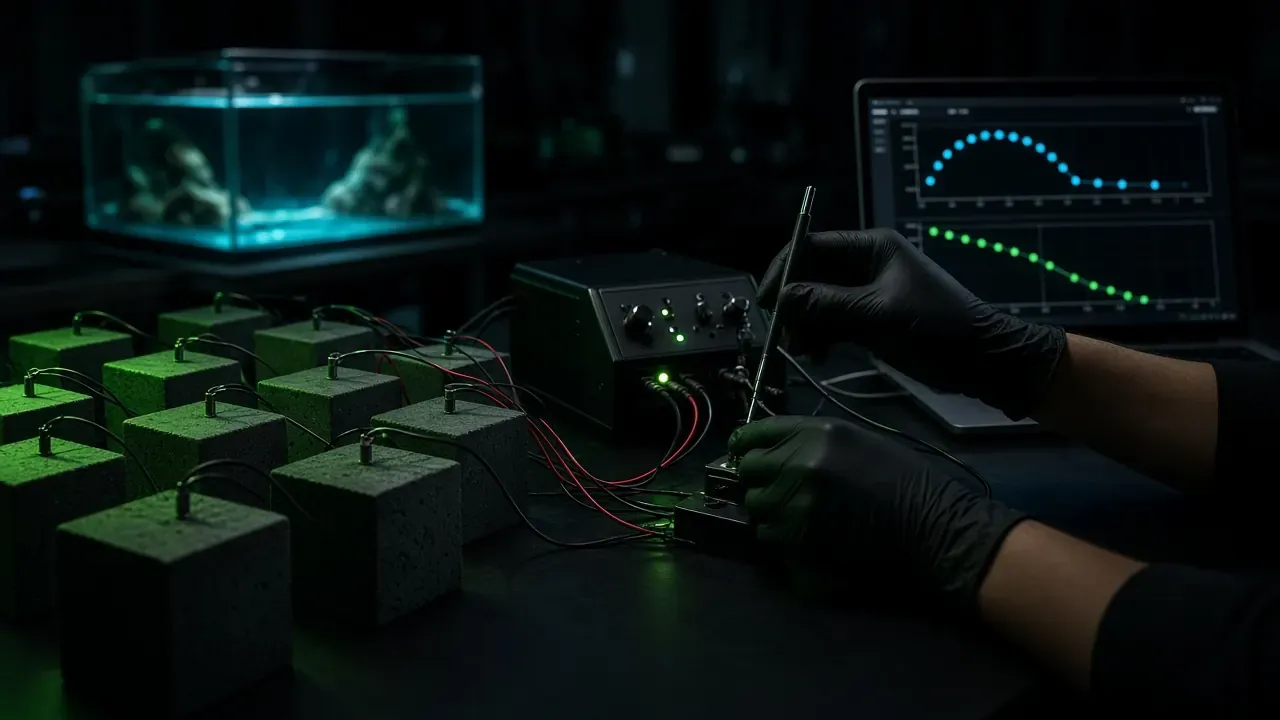
GeoVoltaic® is a self-deconstructing galvanic battery for ocean-floor sensors. Its concrete housing is the cathode. Seawater is the electrolyte. And when the mission ends, it breaks down into mineral sediment, with no recovery vessel required.
~3.3–3.6 V OUTPUT · 4-CELL MONOLITHIC STACK · <50 m → >4,000 m · NO ELECTRONICS IN THE EOL TRIGGER · 0 kg HARDWARE LEFT TO RECOVER
01 / THE PROBLEM
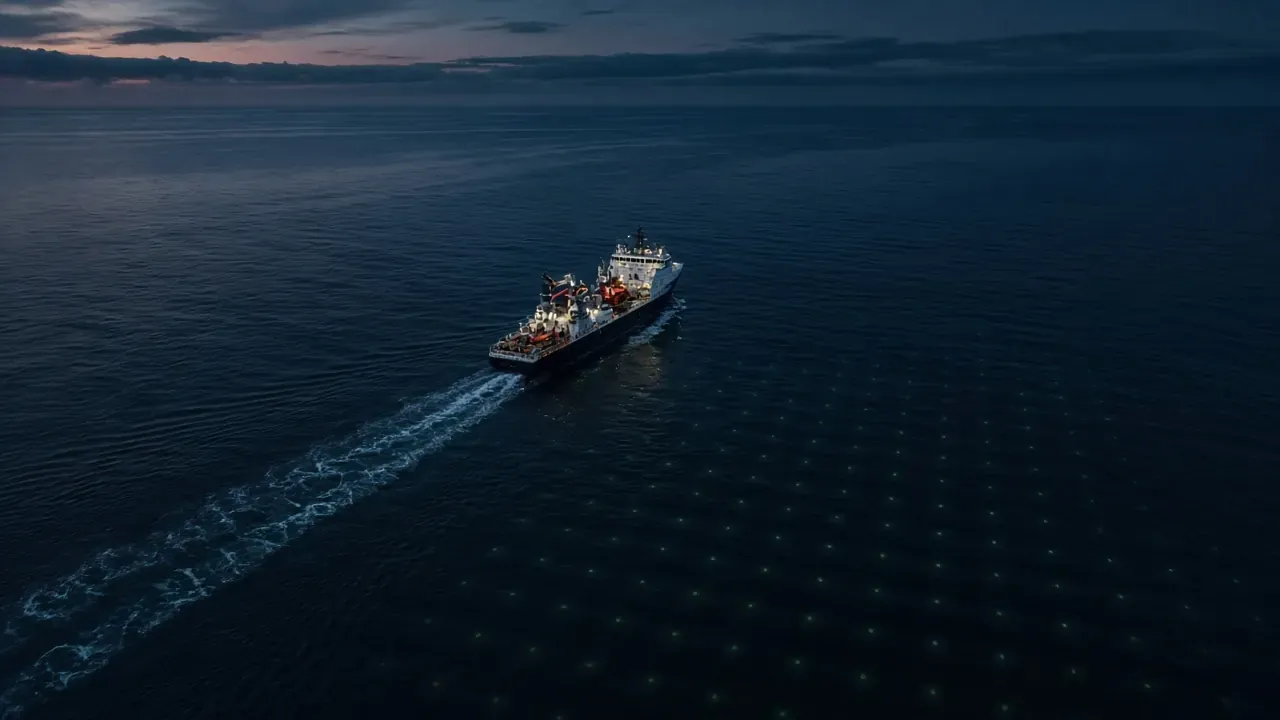
Thousands of autonomous sensor nodes go to the ocean floor every year, at depths reaching 4,000 m. Getting them back depends on ROVs and acoustic releases, and both can fail. When they do, a lithium pack and a synthetic housing stay on the seabed. Permanently.
The industry kept improving recovery. Nobody redesigned the battery so that recovery no longer matters.
recovery failure rate per major survey. Over a fleet's lifetime, that adds up to hundreds of lost instruments.
ⓘ Sourcehydrostatic pressure at 4,000 m. Every gram of hardware down there is expensive to retrieve.
ⓘ Sourcehow long lithium cells and synthetic housings can leach into the marine environment. Neither biodegrades.
ⓘ Sourcelithium packs cap mission length, compress recording windows, and let clock drift build up before nodes can be recalibrated.
ⓘ Source02 / THE INVENTION
Three interlocking design paradigms. Zero non-biodegradable hardware.
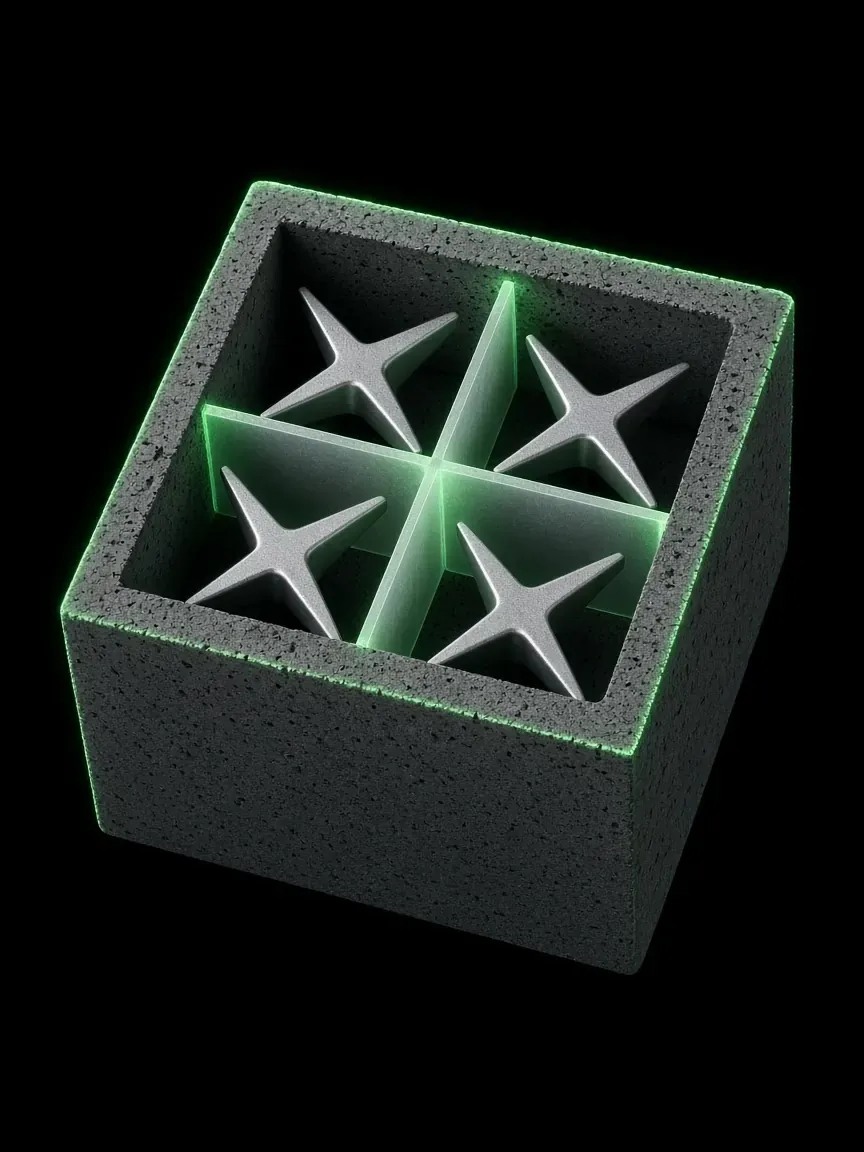
Schematic. Not to scale. Based on patent-pending design (US provisional).
A conductive cementitious matrix (Portland cement with MWCNTs and graphite) does two jobs at once. It is the mooring anchor that holds the node on the seabed and the 3D current-collecting cathode that powers it.
A 3D-printed PHA bioplastic framework divides the block into four isolated cells. One pour, one cast, one monolith, with each quadrant electrochemically separate.
Pull a mechanical iron-pin plug. Seawater shorts the cells, the magnesium anodes swell into hydroxide, and the housing fractures from within. No electronics, no firmware, nothing to fail.
Think of it as a battery built like a reef. The concrete is the skeleton, seawater is the bloodstream, and magnesium is the fuel it slowly burns.
03 / END OF LIFE
Most hardware is designed to last. GeoVoltaic® is also designed to stop existing on command.
Anode expansion 1.00×
Mg → Mg(OH)₂ ≈14.0 → ≈24.9 cm³/mol VOLUME RATIO ≈ 1.78× Concrete tensile strength: typically a few MPa. Confined expansion does the rest.
Mg 1.74 g/cm³; Mg(OH)₂ ≈ 2.34 g/cm³.
We claim the end state is non-toxic. We want researchers to test that claim rigorously, and publish whatever they find. Track 05
04 / SPECIFICATIONS
What's defined, what's claimed, and what's still open. We'd rather show you the gaps than hide them.
~3.3–3.6 V · 95–140 mA (active phase)
4-cell series stack, monolithic cast block
Pure Mg / Mg alloy, star-shaped cross-section
Portland cement + 2% MWCNTs + 8% graphite
PHA bioplastic (PHB, PLA, starch also claimed)
Mechanical iron-pin plug, no electronics
Shallow coastal (<50 m) → deep ocean (>4,000 m)
Cascading fracture over days–weeks
None required
Wh/kg: RESEARCH OPEN → Track 01 / 02
OpenDays at depth: RESEARCH OPEN → Track 01
OpenRESEARCH OPEN → Track 05
05 / JOIN THE MISSION
THESIS POSITIONS OPEN
GeoVoltaic® is recruiting MSc and PhD researchers for thesis projects on a real, patent-pending marine energy system. These aren't sandbox exercises. Each track answers a question that decides whether this technology reaches the seabed.
Work directly with the inventor, Sigurd Erik Demos Oesterud, alongside your academic advisor.
Your thesis tests a patent-pending design aimed at a defined licensing market.
The patent priority date is established, so results can be published after a short, predefined IP review window.
Clean-tech, marine energy, and advanced materials, in one line on your CV.
Pick one of the eight, or propose your own angle.
Include your CV and a few paragraphs on your approach.
A 30-minute technical call.
A three-way meeting to align academic and project goals.
A clear thesis agreement covering IP, publication, and confidentiality.
Yes. A US provisional patent application has been filed, so the priority date is established. Publications go through a short IP review window before submission. That window is for review, not suppression.
Terms are agreed in writing before work starts and aligned with the university's IP policy.
The technical disclosure on this site is non-confidential. Deeper design details are shared under a standard NDA where a track needs them.
Yes. Tracks are designed to fit standard MSc and PhD structures at any university.
Co-supervision and technical documentation.
Signal received. We'll reply. In the meantime, send your advisor the briefing.
06 / IMPACT
Small percentages, very large oceans. Model your own fleet.
0
0
Battery hardware left behind with GeoVoltaic®: 0.
Illustrative model based on the 1–5% per-survey recovery-failure range cited in our technical disclosure. Adjust the inputs to match your operations.
07 / MARKET
OBN / OBS MANUFACTURERS · SEISMIC SURVEY CONTRACTORS · SUBSEA INSTRUMENTATION · OFFSHORE WIND · ENVIRONMENTAL MONITORING
Designed as a replacement for existing OBN/OBS battery formats. No change to vessel operations.
Addresses environmental-liability requirements that are increasingly part of offshore survey permitting.
One concept, with the mix design adapted to the depth, from coastal shelves to the abyssal plain.
Eight tracks. One system. A thesis that ends on the ocean floor, and starts your career.